Now let’s prepare the cake batter.
Begin with good-quality unsweetened cocoa powder. Any reputable brand will work, but choosing a higher-quality cocoa improves flavor and depth in the finished cake.
Pour boiling water over the cocoa powder and whisk until it becomes a smooth, glossy mixture. Allow it to cool for a few minutes before adding other ingredients so it won’t curdle eggs or melt butter excessively.
Mix until fully dissolved and smooth, then set the chocolate base aside to cool slightly while you prepare the dry ingredients.
Whisk together the dry ingredients — cake flour, sugar, baking powder, and salt — until evenly combined and free of lumps. Many chiffon recipes call for sifting to ensure a light texture; if your ingredients are not clumpy, a brisk whisk will usually do the job. In very humid conditions you may want to sift to be safe.
Into the cooled cocoa mixture, stir in melted butter and a bit of neutral oil for extra tenderness and moisture. Combine until homogeneous.
Add the eggs and vanilla, beating just to incorporate. Then add the dry flour mixture to the chocolate base.
Mix on low speed until the ingredients come together, then increase to medium and beat for about three minutes to develop a smooth, slightly aerated batter.
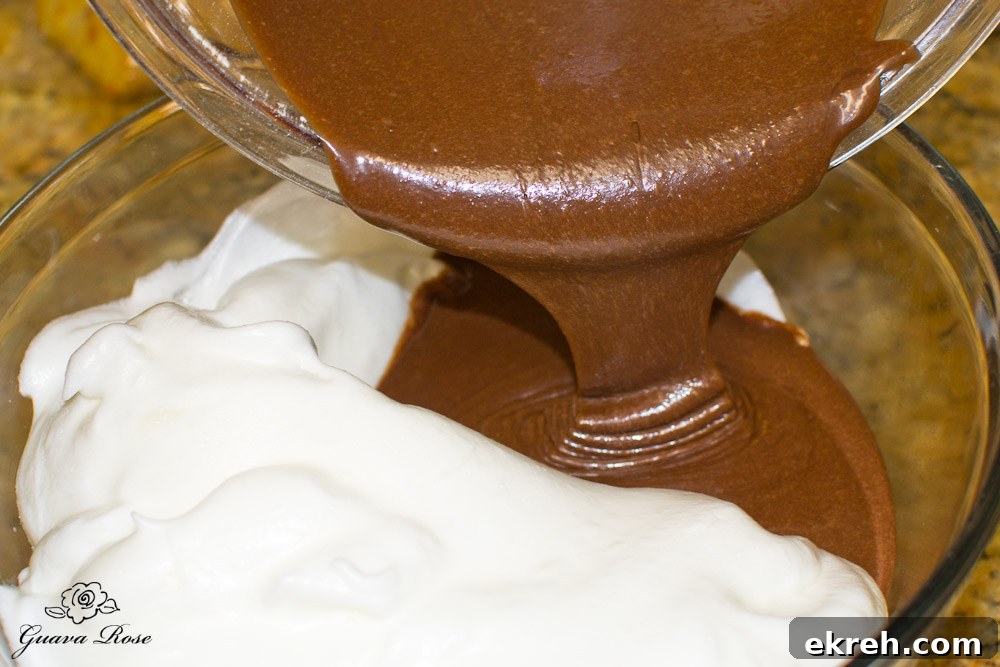
Pour the chocolate batter into the bowl that already contains whipped egg whites. The heavier batter will sink beneath the whites — that’s intentional. I often whip the egg whites first to avoid having to clean the mixer between steps, but you can prepare them in either order.
Fold the whites into the batter gently to retain as much air as possible. Use a flexible spatula: insert it to the bottom of the bowl on one side, draw batter up from underneath, then lift and fold it over the top. Repeat around the bowl, rotating the bowl slowly to reach all areas.
Avoid stirring or beating in circular motions; that will deflate the whites and reduce the cake’s lift. Continue the “down, under, up and over” motion until no white streaks remain and the batter is uniformly colored.
When fully incorporated the batter should be smooth, even in color, and light in texture — with no pockets of unmixed whites or dry flour.
Prepare a shiny metal cake pan by lining only the bottom with parchment paper. Do not use a non-stick pan: chiffon cakes need to cling to the pan sides as they rise. The parchment helps release the cake cleanly when it’s done.
Transfer the batter to the prepared pan and smooth the top gently. Bake in a preheated 350°F (175°C) oven for about 30–35 minutes, or until a toothpick inserted in the center comes out clean.
The baked cake should be light and springy. To cool, place a rack over the cake pan, invert the pan onto a clean kitchen towel or rack, and allow the cake to cool completely upside down. This prevents collapse and helps maintain height.
Once fully cooled, flip the cake back into its pan if needed, then remove the parchment and pan sides. Proceed to fill and frost the cake, or wrap and refrigerate until you’re ready to assemble.